




How Should a Tailored Blazer Fit? The Complete Guide
A blazer is the most architectural garment in a wardrobe. When it fits, it corrects posture, balances proportion, and disappears into the way you move. When it doesn't, no fabric or price tag can save it. At our Paris atelier, fit is the first conversation we have with every client — and the vocabulary below is the one we use.
The Shoulder: The One Thing You Cannot Alter
Everything begins at the shoulder line. The seam should end precisely where your shoulder bone does — extending just far enough for the sleeve to fall in a clean vertical line. A shoulder that overhangs collapses into divots; one that pinches pulls the whole chest out of balance.
Unlike sleeves or waists, shoulders cannot be meaningfully altered after construction. If a ready-to-wear blazer fails at the shoulder, walk away. This is also why our tailoring keeps the shoulder natural and lightly structured: it should follow your anatomy, not impose a new one.
The Chest and the Canvas
Button the jacket and slide a flat hand between the lapel and your chest. It should glide without strain and without hollow space. An X-shaped pull at the closed button means the chest is too tight; vertical ripples mean excess cloth.
What most guides omit: the behaviour of the chest depends on what lies beneath the wool. A hand-stitched canvas — never fused with adhesive — moulds to the body with wear, so a canvassed blazer that fits well on day one fits better in year three.
Sleeve Length and the Shirt Cuff
With arms relaxed, the jacket sleeve should end at the wrist bone, letting half a centimetre to a centimetre of shirt cuff show. This sliver of linen or cotton is not decoration — it protects the jacket edge and visually finishes the arm. Too long, and the whole silhouette reads as borrowed; too short, and the jacket looks outgrown.
Jacket Length and Proportion
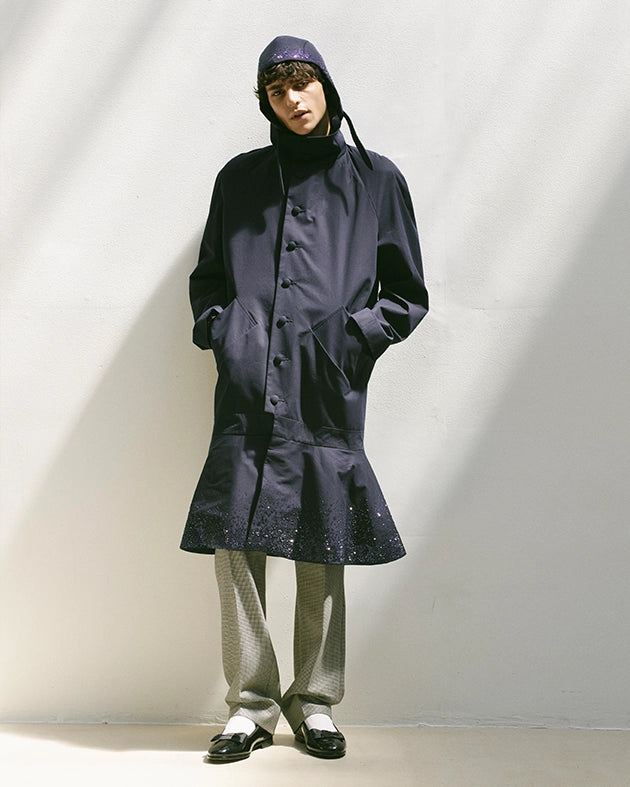
The classic rule places the hem so it covers the seat, with your knuckles roughly level with the bottom edge when arms hang naturally. But proportion matters more than rules: a longer line elongates, a cropped line sharpens. In our collections we often play with asymmetric and elongated silhouettes precisely because length is the most expressive dimension of tailoring — once shoulder and chest are resolved.
Waist Suppression: Shape Without Constraint
A well-cut blazer narrows through the waist enough to define a silhouette, never enough to restrict a full stride or a deep breath. Sit down wearing the jacket buttoned. If it gapes, pulls, or rides up aggressively, the balance between chest and waist needs work.
When Ready-to-Wear Reaches Its Limit
Standard sizing is built for a statistical body. Sloping or square shoulders, a difference between chest and waist beyond the standard drop, one arm longer than the other — these are not flaws, they are simply facts that ready-to-wear cannot answer.
This is where made-to-measure begins. In our atelier, 3D body scanning captures your exact posture and proportions, which our tailors then interpret by hand — delivering a garment cut for your body in two to three weeks.
The Fitting-Room Checklist
- Shoulder seam ends at the shoulder bone — no divot, no pinch
- Flat hand slides under the closed lapel without strain
- No X-pull at the button, no vertical ripples in the chest
- 0.5–1 cm of shirt cuff visible at the wrist
- Hem covers the seat; proportions balanced to your height
- You can sit, reach, and breathe with the jacket buttoned
Explore our menswear blazers and womenswear blazers, each built on a hand-stitched canvas. Or book a private appointment at 30 Rue Jacob to have your measurements taken properly — the ten most useful minutes you can give your wardrobe.

Written by Steven Passaro