


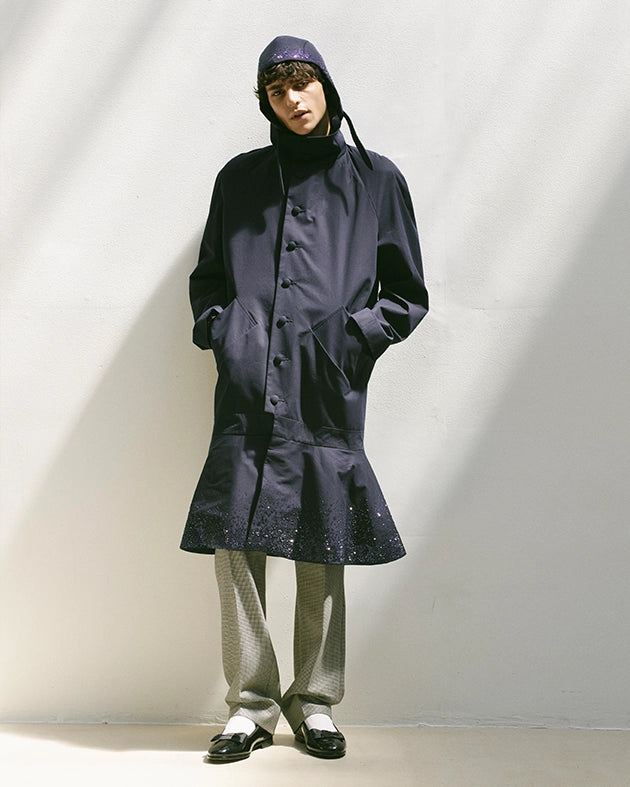

Article: What Is Bespoke Tailoring? A Guide to the Art of Made-to-Measure

What Is Bespoke Tailoring? A Guide to the Art of Made-to-Measure
There is a quiet ceremony to bespoke tailoring — a series of measured gestures, each one carrying the weight of centuries of craft. It begins not with fabric, but with a conversation. A shared understanding of how a garment should feel against the body, how it should move, where it should hold and where it should give.
Bespoke, Made-to-Measure, and Ready-to-Wear: Understanding the Difference
The word bespoke originates from Savile Row, where a length of cloth was said to "be spoken for" — reserved for a particular client. A bespoke garment is created entirely from scratch: a unique pattern is drafted for your body, and every decision — from the curve of the lapel to the weight of the canvas — is made in dialogue between you and the tailor.
Made-to-measure sits between bespoke and ready-to-wear. An existing pattern is adapted to your measurements, offering a precise fit without the full atelier process. At Steven Passaro, our made-to-measure service delivers a bespoke-level experience — 3D body scanning meets hand-finishing, with completion in two to three weeks.
Ready-to-wear, by contrast, is designed for standard sizing. Our collections are cut with the same couture precision, but the fit is universal rather than individual.
The Fitting: Where the Garment Begins to Breathe
A first fitting is an act of translation. The tailor reads the body — not just its dimensions, but its posture, its asymmetries, the way it carries tension. In our Paris atelier, this begins with 3D scanning technology that captures hundreds of data points in seconds, which our tailors then interpret through the lens of traditional couture technique.
Nothing replaces the hand. The drape of a wool across the shoulder, the way a sleeve falls when the arm is at rest — these are judgments that belong to the eye and the fingertip. Technology is a tool, not a replacement.
Fabric: The First Decision That Matters
We work primarily with European mills — Italian wool, French silk, Portuguese cotton. Each fabric is chosen not only for its aesthetic but for its behaviour: how it presses, how it ages, how it responds to the body's warmth over the course of a day.
For tailored jackets and trousers, we favour structured wools with natural recovery. For shirts and softer pieces, we turn to cotton voiles and washed silks that collapse beautifully against the skin. Every fabric in our atelier has been tested, worn, and questioned before it earns its place.
Construction: The Architecture Beneath
A Steven Passaro jacket is built in layers. The canvas — a horsehair interlining that gives the chest its shape — is hand-stitched to the wool, never fused with adhesive. This allows the jacket to mould to your body over time, developing a fit that improves with wear.
The buttonholes are hand-cut and stitched with silk thread. The seams are pressed open and finished clean. These are not visible details, but they are the ones that determine whether a garment lasts a season or a decade.
Why Bespoke Still Matters
In a world saturated with disposable fashion, bespoke tailoring is an act of intention. It asks you to slow down, to consider what you actually want from a garment — not just how it looks, but how it makes you feel. It is clothing as self-knowledge.
If you are considering your first bespoke commission, we invite you to book a private appointment at our Paris atelier. The conversation is the beginning.

Written by Steven Passaro